Open Mon - Fri   8:30am - 5:00pm
ABOUT   CONTACT    
FREE Shipping

Common Car AC Condenser Problems & How to Fix Them

A well-functioning air conditioning (AC) system is essential for comfort during drives, especially in warmer climates. At the heart of this system lies the car AC condenser, responsible for dissipating heat from the refrigerant, allowing the system to blow cool air into the cabin. When the condenser encounters issues, it can compromise the entire AC system’s performance. Understanding common auto AC condenser problems can help in early detection and prevent costly repairs.

Understanding the Role of the Automotive AC Condenser

The automotive AC condenser is a heat exchanger located at the front of the vehicle, typically in front of the radiator. It converts high-pressure, high-temperature refrigerant gas from the compressor into a high-pressure liquid by releasing heat to the outside air. This process is crucial for the refrigerant to cycle back and absorb more heat from the cabin, ensuring continuous cooling.

Top 10 Common Car AC Condenser Problems

1. Reduced Cooling Efficiency

When the car AC condenser is clogged or damaged, it can’t effectively dissipate heat, leading to warmer air from the vents. Common causes include debris accumulation or bent fins restricting airflow.

2. Refrigerant Leaks

Leaks can occur due to corrosion, physical damage, or faulty seals, leading to a drop in refrigerant levels and reduced cooling performance. Signs include oily spots on the condenser or a hissing sound.

3. Physical Damage

Being at the front, the auto AC condenser is highly susceptible to damage from road debris, accidents, or minor collisions, which can cause leaks or blockages.

4. Electrical Issues

Faulty wiring or sensor problems can prevent the car AC condenser fan from operating, leading to overheating and reduced AC efficiency.

5. Overheating Engine

A malfunctioning automotive AC condenser can cause the engine to overheat, especially when idling, as the heat exchange process is compromised.

6. Unusual Noises

Rattling or banging noises when the AC is on can indicate loose or damaged car AC condenser parts.

7. Burning Smell

A burning odour might result from overheated components or electrical issues within the condenser system.

8. Dashboard Warning Lights

Modern vehicles may display warning lights or error codes related to the AC system when the car AC condenser malfunctions.

9. Increased Cabin Humidity

A failing condenser can lead to inadequate moisture removal, resulting in a humid cabin environment.

10. AC System Shuts Down

Some vehicles automatically disable the AC system when auto AC condenser issues are detected to prevent further damage.

Diagnosing AC Condenser Issues

Proper diagnosis is essential to address car AC condenser problems effectively:

  • Visual Inspection: Check for visible damage, leaks, or debris on the condenser surface.
  • Pressure Testing: Measure the system’s pressure to identify leaks or blockages.
  • Dye Testing: Inject a UV dye into the system to detect leaks using a UV light.
  • Electrical Testing: Ensure all sensors and wiring connected to the automotive AC condenser are functioning correctly.

Repair and Maintenance Solutions

  • Cleaning: Regularly clean the car AC condenser to remove debris and ensure optimal airflow.
  • Seal Replacement: Replace faulty seals to prevent refrigerant leaks.
  • Component Replacement: Damaged car AC condenser parts or fans should be replaced promptly to restore system efficiency.
  • Regular Servicing: Search for “car AC condenser repair near me” and schedule periodic AC system checks with a trusted local technician.

Preventive Measures

  • Protective Grilles: Install grilles to shield the auto AC condenser from road debris.
  • Avoid Overloading: Don’t overload the vehicle, as it can strain the AC system.
  • Prompt Repairs: Address minor issues immediately to prevent them from escalating.

When to Seek Professional Help

If you notice persistent issues like reduced cooling, unusual noises, or warning lights, it’s advisable to consult a certified mechanic. Search online for “car AC condenser repair near me” to find reliable services in your area. Professionals can perform comprehensive diagnostics and recommend appropriate solutions.

A/C Compressor Clutch Replacement Procedure

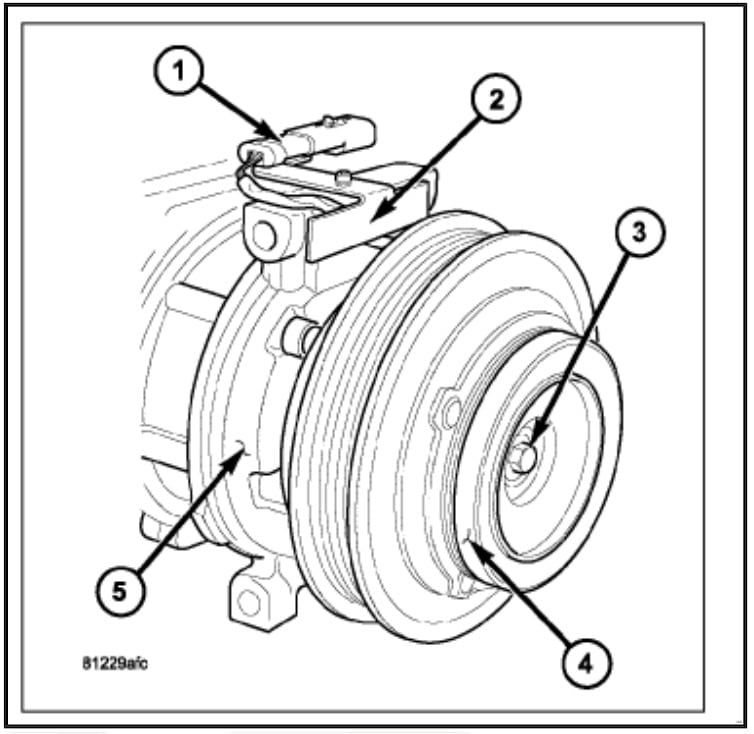
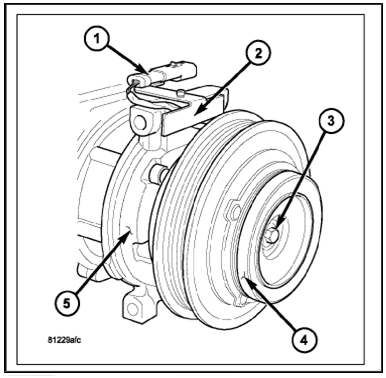
  • A typical A/C compressor is shown in illustrations.

1. Disconnect and isolate the negative battery cable.
2. Remove the accessory drive belt.
3. Disconnect the engine wire harness from the A/C compressor clutch field coil connector (1) located on the top of the A/C compressor (5).
4. Remove the bolts that secure the A/C compressor to the engine and support the A/C compressor.
5. Carefully remove the compressor clutch field coil connector and wire lead from the connector bracket (2).
6. Remove the compressor shaft bolt (3). A band-type oil filter wrench or a strap wrench may be used to hold the clutch plate (4) from rotating during bolt removal.

CAUTION: Do not pry between the clutch plate and the pulley and bearing assembly to remove the clutch plate from the compressor shaft as this may damage the clutch plate.

NOTE: Use care not to lose any clutch shim(s) during the removal of the clutch plate, as they may be reused during the clutch plate installation process.

A/c Compressor Clutch 1

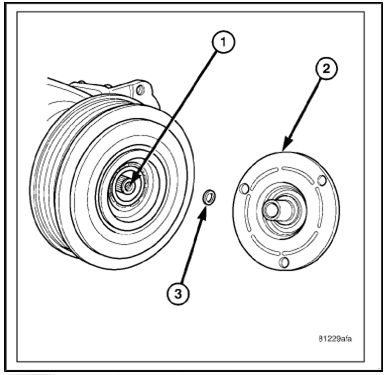
7. Tap the clutch plate (2) lightly with a plastic mallet to release it from the splines on the compressor shaft (1) and remove the clutch plate and shim(s) (3).

A/c Compressor Clutch 2

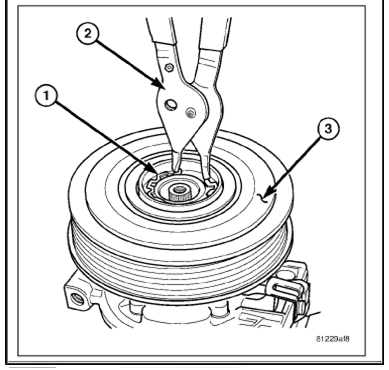
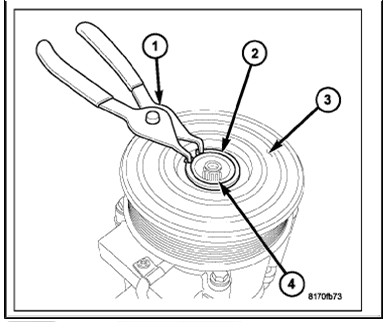
8. Using snap ring pliers (2), remove the snap ring (1) that secures the pulley and bearing assembly (3) to the front of the A/C compressor and remove the pulley and bearing assembly.

A/c Compressor Clutch 3

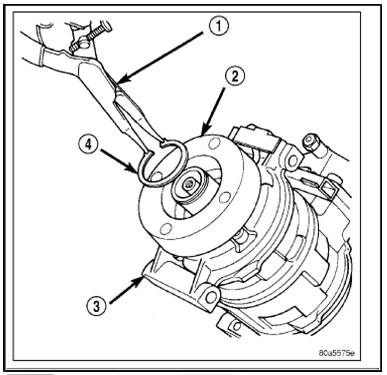
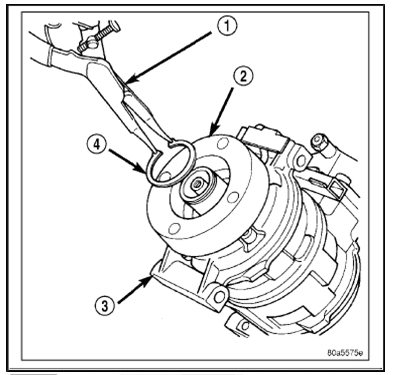
9. Using snap ring pliers (1), remove the snap ring (4) that secures the compressor clutch field coil (2) to the front of the A/C compressor (3) and remove the field coil.

INSTALLATION

NOTE: Typical A/C compressor is shown in illustrations.

A/c Compressor Clutch 4

1. Align the dowel pin on the back of the compressor clutch field coil (2) with the hole in the front of the A/C compressor (3) and position the field coil onto the compressor. Be certain that the compressor clutch field coil wire lead is properly routed so that it is not pinched between the A/C compressor and the field coil.

CAUTION: The snap ring must be installed and seated into the groove or it will vibrate out, resulting in a clutch failure and severe damage to the A/C compressor. Lock the snap ring back into its seating position, securing the compressor clutch field coil to the A/C compressor. The bevel side of the snap ring must face outward and both snap ring eyelets must be oriented to the right or to the left of the field coil dowel pin location on the A/C compressor.

2. Using snap ring pliers install the snap ring (4) that secures the compressor clutch
field coil to the front of the A/C compressor. Check that the snap ring is seated within the groove and oriented correctly.

  • Be certain to position the compressor clutch field coil wire lead so that it is not damaged during A/C compressor pulley and bearing installation.
  • When installing the pulley and bearing assembly, DO NOT mar the friction surfaces of the pulley or premature failure of the clutch will result.
A/c Compressor Clutch 5

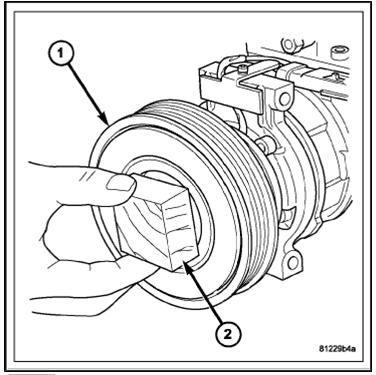
3. Install the pulley and bearing assembly (1) onto the front of the A/C compressor. If necessary, tap the pulley gently with a block of wood (2) placed on the pulley friction surface.

CAUTION: The snap ring must be fully and properly seated in the groove or it will vibrate out, resulting in a clutch failure and severe damage to the A/C compressor. The bevel side of the snap ring must face outward.

A/c Compressor Clutch 6

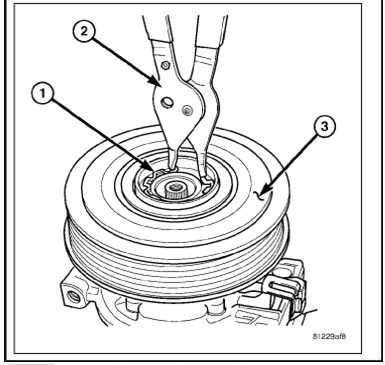
4. Using snap ring pliers (2), install the snap ring (1) that secures the pulley and bearing assembly (3) to the front of the A/C compressor. Be certain that the snap ring is fully and properly seated in the groove.

A/c Compressor Clutch 7

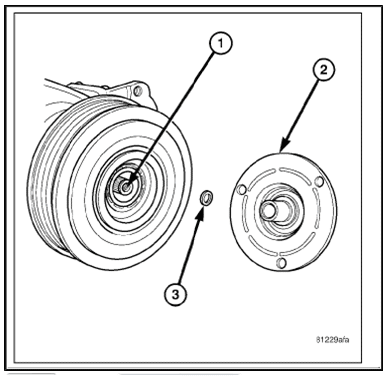
5. If the original clutch plate (2) and pulley and bearing assembly are to be reused, reinstall the original shim(s) onto the compressor shaft (1). If a new clutch plate and pulley and bearing assembly are being used, install a trial stack of shims 2.54 mm (0.010 in.) thick onto the compressor shaft.

A/c Compressor Clutch 8

6. Install the clutch plate (4) onto the front of the A/C compressor (5).
7. Install the compressor shaft bolt (3). Tighten the bolt to 19 N.m (168 in.lbs.)

  • The shims may compress after tightening the shaft bolt. Check the air gap in four or more places to verify the air gap is correct. Spin the pulley before performing a final check of the air gap.
  • On models with the clutch plate recessed into the pulley, use a 90-degree wire gap gauge to measure the clutch air gap. On other models, use a blade-type feeler gauge to measure the air gap.

8. With the clutch plate assembled tight against the shim(s), measure the air gap between the clutch plate and the pulley and bearing assembly. The air gap should be between 0.35 – 0.60 mm (0.014 – 0.024 in.). If the air gap is not between specifications, add or subtract shims as needed until the correct air gap is obtained.

CAUTION: Be certain that the compressor clutch field coil wire harness is properly routed so that it is not pinched between the A/C compressor and the field coil connector bracket.

9. Carefully route the compressor clutch field coil wire lead behind the connector bracket (2).
10. Install the compressor clutch field coil connector (1) onto the connector bracket.
11. Position the A/C compressor to the engine and install the retaining bolts.
12. Connect the engine wire harness to the compressor clutch field coil connector.
13. Install the accessory drive belt.
14. Reconnect the negative battery cable.

VISTEON STYLE COMPRESSOR

REMOVAL

NOTE: If the A/C compressor clutch can be serviced in the vehicle, the refrigerant system can remain fully charged during compressor clutch, pulley and bearing assembly or field coil replacement.

A/c Compressor Clutch 10

1. Disconnect and isolate the negative battery cable.
2. Remove the accessory drive belt.
3. Raise and support the vehicle.
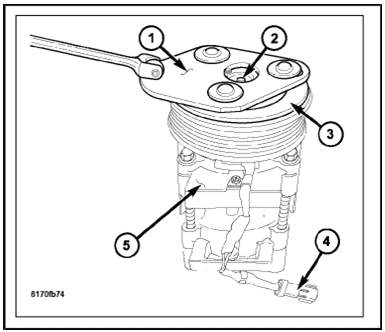
4. Disconnect the engine wire harness from the clutch field coil connector (4).
5. Remove the bolts that secure the A/C compressor (5) to the mounting bracket.
6. Remove the A/C compressor from the mounting bracket and support the compressor while servicing the clutch.
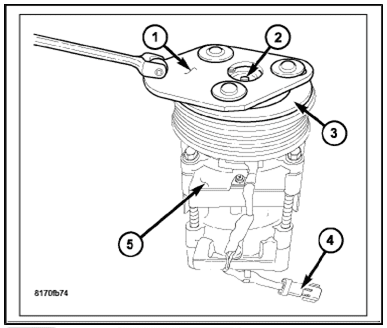
7. Using compressor clutch holding fixture (1), remove the bolt (2) that secures the clutch plate (3) to the compressor shaft.

  • The clutch plate can be removed from the compressor shaft by hand or, if required, pressed off with an 8 x 1.25 mm bolt.
  • Clutch plate shim(s) may remain inside the hub of the clutch plate. Be sure to remove all of the shims from inside the hub or from the end of the compressor shaft.
A/c Compressor Clutch 11

8. Remove the clutch plate and shim(s) from the A/C compressor. If required, install an 8 x 1.25 mm bolt into the centre of the clutch plate and turn the bolt clockwise until the clutch plate is completely removed from the A/C compressor.
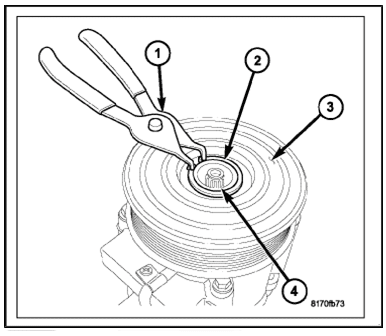
9. Using snap ring pliers (1), remove the snap ring (2) that secures the pulley and bearing assembly (3) to the front of the A/C compressor (4).

NOTE: The pulley and bearing assembly can be removed from the compressor by hand or, if required, with a two-jaw puller.

A/c Compressor Clutch 12

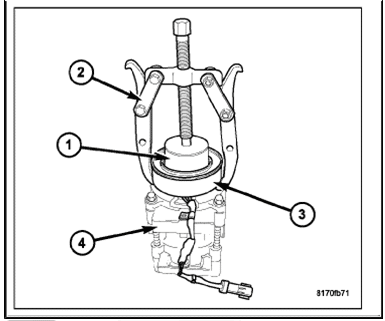
10. Remove the pulley and bearing assembly (1) from the front of the A/C compressor (2). If required, install a two jaw puller (3) and turn the puller centre-bolt clockwise until the pulley and bearing assembly are completely removed.
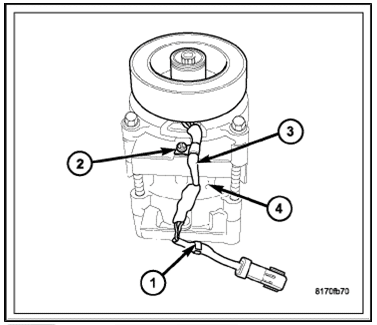
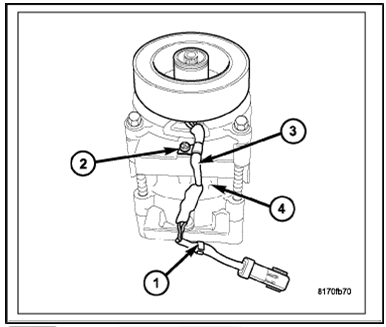
11. Remove the plastic retaining clip (1) and the screw (2) that secures the clutch field coil wire lead and connector (3) to the A/C compressor (4).

A/c Compressor Clutch 13

12. Using compressor field coil remover tool (1) and a two jaw puller (2), remove the clutch field coil (3) from the front of the A/C compressor (4).

INSTALLATION

A/c Compressor Clutch 14

1. Position the A/C clutch field coil (1) squarely onto the front of the A/C compressor (2).

CAUTION: Position the A/C clutch field coil so that the coil positioning tabs and the wire harness lead are oriented in the correct direction. Failure to correctly position the field coil on the A/C compressor will result in field coil damage.

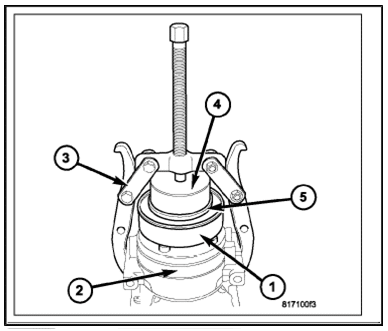
2. Align the field coil positioning tabs to the recessed area at the front of the A/C compressor and install the clutch field coil onto the compressor using a two jaw puller (3), compressor field coil installer tool (4) and the compressor field coil installer spacer (5)

A/c Compressor Clutch 15

3. Position the clutch field coil wire lead and connector (3) to the A/C compressor (4) and install the plastic retaining clip (1) and the screw (2) that secures the wire lead to the compressor. Tighten the screw to 4 N.m (35 in. lbs.).

A/c Compressor Clutch 16

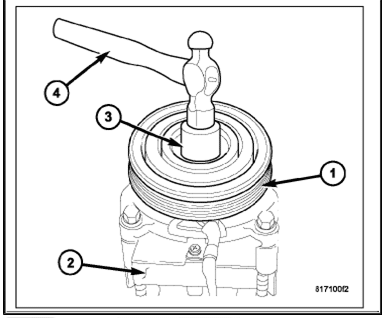
4. Align the pulley and bearing assembly (1) squarely onto the front of the A/C compressor (2).

NOTE: A distinct change of sound during the clutch pulley tapping process indicates that the pulley and bearing assembly has bottomed out against the compressor housing.

5. Using a clutch pulley installation tool (3) and a small plastic or rubber hammer (4), install the pulley and bearing assembly onto the front of the A/C compressor. Tap the installer with a hammer until the pulley and bearing assembly has bottomed against the compressor housing.

CAUTION: If the snap ring is not fully seated in the groove it will vibrate out, resulting in clutch failure and severe damage to the A/C compressor.

NOTE: Install the snap ring with the beveled side of the snap ring facing outward.

A/c Compressor Clutch 17

6. Using snap ring pliers (1), install the snap ring (2) that secures the pulley and bearing assembly (3) to the front of the A/C compressor (4). Make sure the snap ring is properly seated in the groove.

A/c Compressor Clutch 18

7. Verify that there is adequate clearance for the clutch field coil wire lead and connector (4) between the compressor housing and the pulley.

NOTE: When installing an original or a new clutch assembly, try the original shims first. When installing a clutch onto a compressor that previously did not have a clutch, use the 1.0, 0.50 and 0.13 millimeter (0.040, 0.020 and 0.005 inch) shims from the clutch hardware package which is provided with the new clutch.

8. Install the clutch shims onto the compressor shaft.
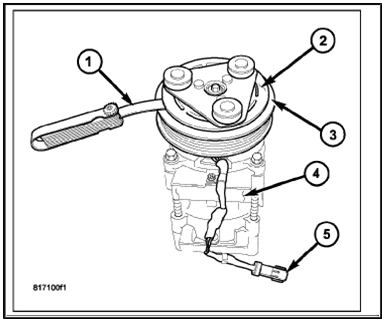
9. Using a A/C compressor clutch holding fixture tool (1), install the bolt (2) that secures the clutch plate (3) to the A/C compressor (5). Hold the clutch plate stationary with the holding fixture and tighten the bolt to 15 N.m (133 in. lbs.)

A/c Compressor Clutch 19

10. Using a feeler gauge (1), check the air gap between the clutch plate (2) and the pulley and bearing assembly (3). If the air gap is not 0.35 to 0.75 millimeter (0.014 to 0.030 inch), add or subtract shims as required.
11. Position the A/C compressor (4) onto the mounting bracket.
12. Install the bolts that secure the A/C compressor to the mounting bracket. Tighten the bolts to 23 N.m (17 ft. lbs.).
13. Connect the engine wire harness to the compressor clutch field coil connector (5).
14. Lower the vehicle.
15. Install the accessory drive belt.
16. Reconnect the negative battery cable.
17. Perform the Clutch Break-in Procedure.

The Function of an AC Compressor in a Car’s Air Conditioning System

The air conditioning (AC) system in a car plays a vital role in keeping the interior of the vehicle comfortable and cool, especially during hot summer months. One of the key components of the AC system is the compressor, which is responsible for circulating the refrigerant throughout the system and helping to cool the air inside the car.

The AC compressor is typically driven by the engine via a belt and pulley system and is located at the front of the engine. When the AC system is turned on, the compressor starts to run and begins to pressurise the refrigerant, which is typically a type of refrigerant gas such as R-134a.

As the refrigerant is pressurised, it becomes hot and is sent to the condenser, which is a radiator-like component located in front of the engine. The condenser helps to cool the refrigerant and convert it from a gas back into a liquid.

From the condenser, the refrigerant is sent to the evaporator, which is located inside the car. The evaporator is responsible for absorbing heat from the air inside the car and transferring it to the refrigerant, which helps to cool the air.

As the refrigerant absorbs heat from the air, it vaporises and turns back into a gas. The cooled, pressurised gas is then sent back to the compressor to start the process over again.

In addition to circulating and pressurising the refrigerant, the AC compressor also plays a crucial role in regulating the flow of refrigerant throughout the system. It does this through the use of a pressure switch, which helps to ensure that the system is operating at the correct pressure levels. If the pressure becomes too high or too low, the pressure switch will turn the compressor off to prevent damage to the system.

In summary, the car air conditioner compressor is a vital component of a car’s air conditioning system. It is responsible for circulating and pressurising the refrigerant, and it helps to regulate the flow of refrigerant throughout the system. When it comes to maintaining your car AC parts, Cool Car Air Conditioning in Australia specialises in providing efficient and effective services. To know more about them you can visit their website www.coolcarairconditioning.com.au or contact them at 0246665497. 

How to Prolong the Life of Your AC Compressor

The air conditioner compressor is an important component in your cooling system and a major investment in your car. A malfunctioning compressor can lead to costly repairs or even complete replacement of the entire unit. Hence Here are some tips on how to prolong the life of your AC compressor and ensure its longevity.

Regular Maintenance: Regular maintenance of your AC unit is critical in prolonging the life of the compressor. Hire a professional HVAC technician to perform a thorough cleaning and inspection of your unit twice a year, in spring and fall. This will help detect and address any issues before they become more significant problems.

Correct Sizing: It is important to ensure that your AC unit is correctly sized for your car. An undersized unit will have to work much harder to cool your car, leading to more wear and tear on the compressor. On the other hand, an oversized unit will cycle on and off frequently, putting extra stress on the compressor.

Proper Installation: A proper installation is crucial in prolonging the life of your AC compressor. Make sure the unit is installed on a level surface and that all electrical connections are secure. If the unit is not installed correctly, it can cause vibration and stress on the compressor, leading to premature failure.

Keep the Area Around the Unit Clean: The area around the AC unit should be kept clean and free of debris, such as leaves and grass clippings. Debris can block the flow of air and cause the unit to work harder, leading to more wear and tear on the compressor.

Regular Filter Changes: Regular filter changes are critical in maintaining the longevity of your AC compressor. A dirty filter can restrict the airflow to the unit, causing the compressor to work harder and leading to premature failure. Make sure to change your filter at least every three months.

Avoid Overloading the Unit: Avoid overloading the unit by using it excessively on hot days or by cooling too many rooms at once. Overloading the unit can cause the compressor to work harder and lead to premature failure.

Use a Programmable Thermostat: A programmable thermostat can help prolong the life of your AC compressor by allowing you to set the temperature at a comfortable level when you are in the car, and at a higher temperature when you are away. This will help reduce the amount of time the compressor has to work, leading to less wear and tear.

Keep the Refrigerant at the Correct Level: The refrigerant level in your AC unit should be kept at the correct level to ensure optimal performance and longevity of the compressor. A professional HVAC technician can check and adjust the refrigerant level as needed.

In conclusion, prolonging the life of your AC compressor requires regular maintenance, proper installation, and a few simple steps to ensure optimal performance. By following these tips, you can keep your AC unit running smoothly and avoid costly repairs or replacements in the future.

What does the TX valve do on a car’s air conditioning?

In the realm of car air conditioning repair, understanding the TX valve is akin to holding the key to unlocking optimal cooling performance. At Cool Car Air Conditioning, we’ve made it our mission to decode the mysteries of the TX valve and empower you with the knowledge needed to keep your car’s AC system running seamlessly. The world of TX valves provides the insights and expertise you need to master car AC repair like a pro.

Understanding the TX Valve: What You Need to Know

The TX valve, short for thermal expansion valve, plays a crucial role in regulating the flow of refrigerant in your car’s AC system. Located between the evaporator and the air condenser, the TX valve controls the amount of refrigerant entering the evaporator, ensuring optimal cooling performance inside your vehicle.

But what happens when the TX valve malfunctions or becomes clogged? That’s where our expertise comes in. With over two decades of experience in the cool car air conditioning industry, we’ve seen it all when it comes to TX valve issues. From stuck valves to clogged passages, we know how to diagnose and repair TX valve problems quickly and effectively.

The Importance of Proper Maintenance

Like any other component of your car’s AC system, the TX valve requires regular maintenance to ensure peak performance. Over time, dirt, debris, and contaminants can build up inside the valve, leading to reduced efficiency and cooling power. That’s why it’s essential to have your TX valve inspected and serviced regularly by a qualified technician.

At Cool Car Air Conditioning, we take pride in our meticulous approach to maintenance. Our skilled technicians conduct thorough inspections of your car’s AC system, including the TX valve, to identify any potential issues before they escalate into major problems. Whether it’s cleaning the valve, replacing worn-out components, or adjusting the valve’s settings, we have the expertise and tools needed to keep your AC system running smoothly.

Common TX Valve Problems and Solutions

Despite its small size, the TX valve can cause significant headaches when it malfunctions. Some common problems associated with the TX valve include:

  • Stuck valve: If the TX valve becomes stuck in the closed position, it can restrict the flow of refrigerant, leading to poor cooling performance.
  • Clogged valve: Over time, the TX valve can become clogged with dirt, debris, or contaminants, hindering its ability to regulate refrigerant flow effectively.
  • Valve leaks: A leaking TX valve can allow refrigerant to escape from the system, resulting in reduced cooling power and potential damage to other components.

Fortunately, our team at Cool Car Air Conditioning is well-equipped to tackle these and other TX valve issues. Whether it’s repairing a stuck valve, cleaning out clogged passages, or replacing a faulty valve altogether, we have the skills and expertise needed to get your AC system back up and running in no time.

Trust Cool Car Air Conditioning for All Your Car AC Repair Needs

When it comes to car AC repair, Cool Car Air Conditioning is your trusted partner. With our unrivalled expertise, commitment to quality, and dedication to customer satisfaction, we’re here to ensure that your car’s AC system operates at peak performance year-round.

So why wait? If you’re experiencing issues with your car’s AC system or simply want to ensure that it’s running smoothly, contact Cool Car Air Conditioning today. With our comprehensive range of services, competitive pricing, and friendly, knowledgeable staff, we’re here to meet all your car AC repair needs. Stay cool on the road with Cool Car Air Conditioning.

Contact Cool Car Air Conditioning for a quote and friendly advice.

0
    0
    Your Cart
    Your cart is emptyReturn to Shop
      Calculate Shipping